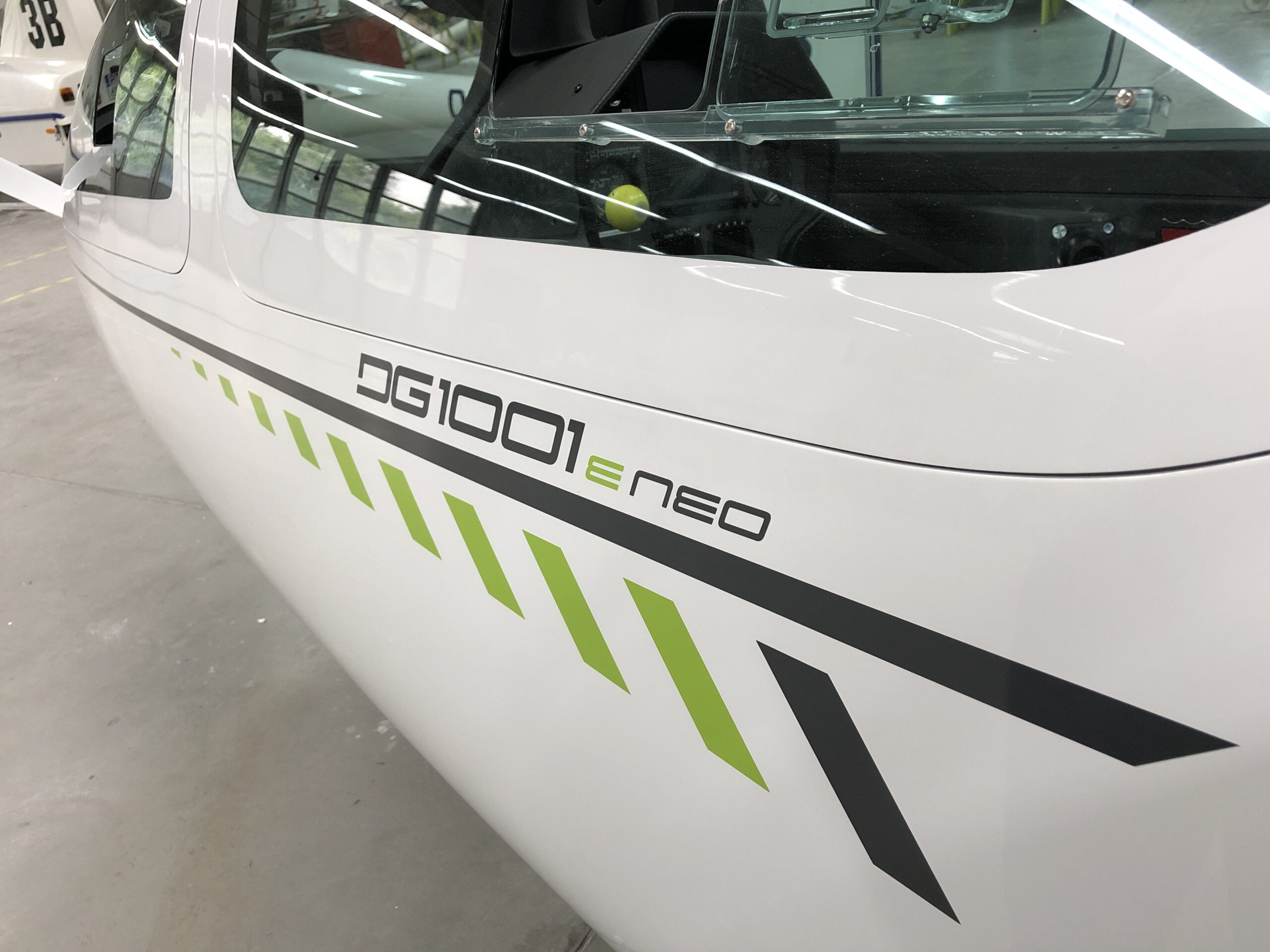
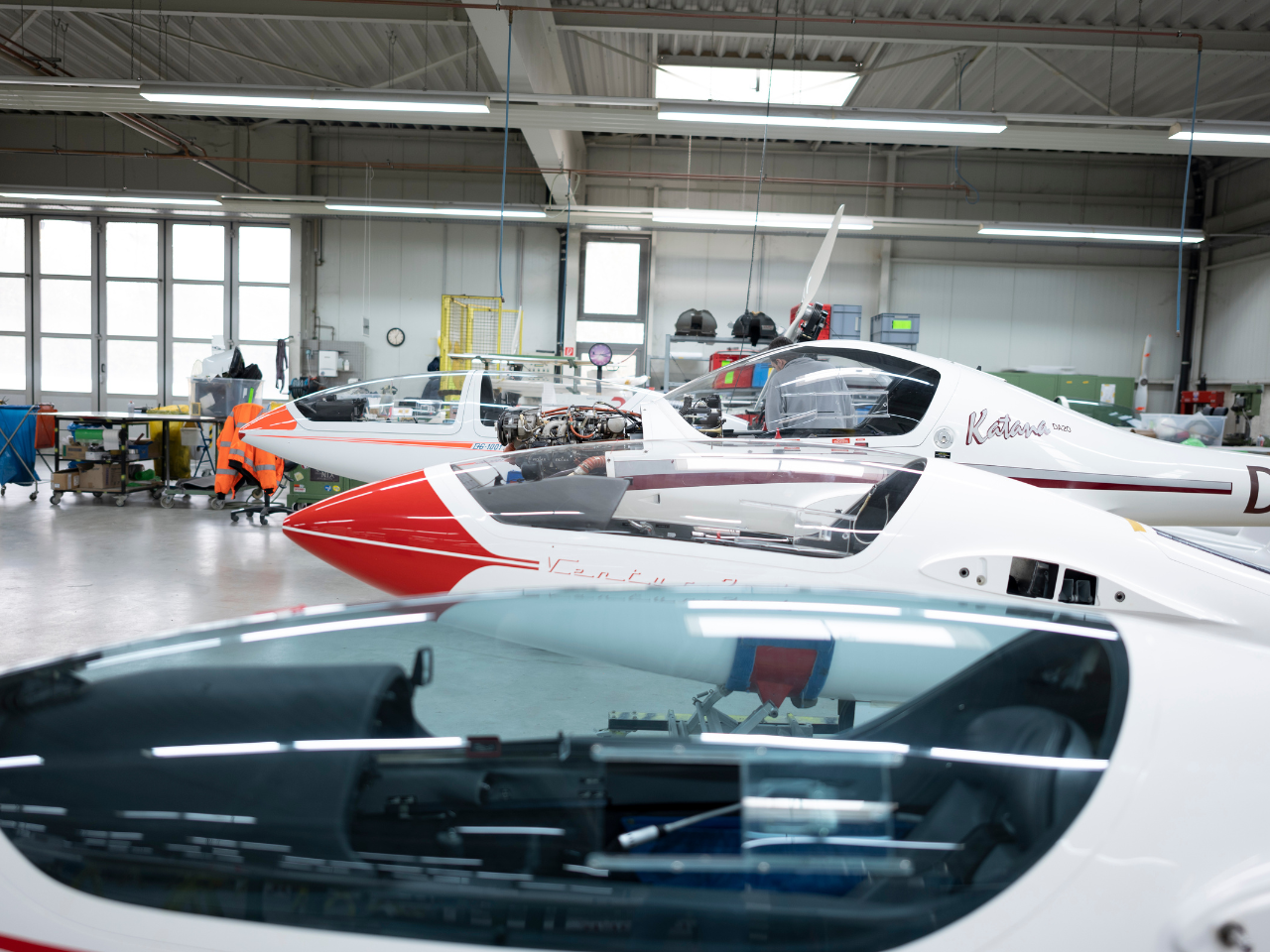

When Wilhelm Dirks designed the DG-100 in the late 70's it came with a dual walled cockpit. This proved to be much stiffer than the usual cockpit designs then in use and offered the pilot real additional protection in case of a crash.
With the passage of time this type of Cockpit became the standard with other manufacturers, too, and the designation "Safety Cockpit" came into common usage for this design. From time to time there were improvement of details, but the basic concept has changed little. Only the use of carbon fiber or a hybrid construction of carbon fiber/Aramid, such as in the DG-808C brought substantial progress once again.
BTW: The cockpit of a DG-800S is still made of GRP.
But it will provide a similar level of protection due to its design criteria.
In 1994 the Technical Supervisory Association of the Rheinland received a research commission to investigate means of improving the pilot safety in sailplanes in the event of a crash. There are extensive reports available. Within the framework of this research commission it was necessary to investigate the conditions in a typical sailplane crash under laboratory conditions.
For this purpose the TSA asked the German sailplane manufacturers to furnish a test fuselage - for proper compensation, of course! There were only refusals. Apparently many manufacturers feared that such a test would show unwanted surprises, and they were not entirely wrong, as we shall see. Only Glaser-Dirks was willing to build a test fuselage, probably because Wilhelm Dirks was convinced of the durability and quality of his design.
And that is how the fuselage for the crash test came about. It is the newest version of the DG-800 in series construction, but without canopy, rear fuselage and fin.
A crash test was conducted of the type otherwise described , a high speed film was made, and Glaser-Dirks was the only company to receive a copy. Basically the results were secret until all investigations were concluded, but as a "participant" Glaser-Dirks was given access to the results. The film was lost for unexplained reasons in the turbulent times of the firm going bankrupt. However, the results of the test have now available to all manufacturers for some time.
Three years later I read an article in "Aerokurier" about the still running research project, called the TSA, spoke to Martin Sperber, a very cooperative expert, and heard for the first time that Glaser-Dirks had furnished the test fuselage, that he would go over the results with me, and that we also could view the "secret" test film.
That is how the already described visit came about..
In the morning we discussed the existing safety cockpit designs and the levels of protection provided to the pilot.
As reported in "Thoughts on Safety Cockpits" these designs provide the pilot with adequate protection in the types of accidents described in cases 1,2 and 3 below:
1. Low speed, nose high, "pancake" landings.
2. Less steep hard landings at an angle of about 10 degrees at normal speeds.
3. Typical out-landing accident, nose 30 degrees down followed by a ground loop; normal speed.
However:
4. Crash at 45 degrees at high speeds, for example from a spin or ramming an obstruction during roll out.
No current cockpit design provides protection in the case 4, the most severe crash.
After lunch we watched the high speed film of the test of case 4 . There were really three films: from the right, from the left, and from above - each about a minute long.
The beginning was the same as in the recent test. At least until the front end of the fuselage contacted the grassy ground in the test container. But after that the following ensued:
The fuselage nose burrows into the grassy surface. After a few centimeters it bends in an upward direction. The fuselage nose comes up out of the ground again and starts to slide up along the surface. This can't be done without overloading the cockpit structure. Bulges run backwards along the sides, and the canopy frame shatters.
The film runs silently except for the hum of the 16 mm camera, which makes the whole event even more ghostly. Amazed and speechless I stared at the wing root with the weights simulating the rest of the aircraft. I expected the rear part of the fuselage to brake and decelerate. It was hard to believe, but the fuselage on it's undercarriage keeps going almost without slowing, while the nose is bent still higher.
Now at a bending angle of about 45 degrees of the canopy frame the instrument panel contacts the forward bent head of the crash dummy and pushes it backward. The weights simulating the aircraft mass push the seat back further forward. Finally the crash dummy sits wedged in between the acutely upwardly bent cockpit nose and the seat back like the proverbial salami in a sandwich. Only now does the rear of the fuselage decelerate abruptly by the fuselage bottom being pressed against the ground, which also compresses the crash dummy. It transmits with it's body the force into the seat back. The crash dummy does not have a compression zone, it is the compression zone!
The end of the film was almost as surprising. The rear fuselage sprang backwards, the elastic fuselage bottom flattened out, and the crash dummy sat "peacefully" in the canopy frame, with slightly soiled pant legs and a bit of grass in the canopy frame, in a cockpit that looked almost undisturbed.
But he was "completely dead!"
The film from the other side showed roughly the same picture. But in the top view one can see how the cockpit is compressed, becomes almost round like a pancake, before it bends up and crushes the crash dummy to a point where a human could not possibly withstand it. It was depressing and fearful.
Finally we saw a second crash film with a special cockpit, built like a tank and not usable in this form. It was not meant to be practical, but only to test if a "survival cockpit" for sailplane pilots is possible. And it held together.
It has to be remembered that some of the materials used came from the Formula 1 sport, which are not at this time licensed for aircraft. This involves especially the "Dyneema" fiber. But at least the test showed what improvements are possible.
It really was a disappointing film - disappointing mainly because our cockpit failed.
This however does not mean that our cockpit is worse than any other. (Remember only Glaser-Dirks were willing to allow their cockpit to be tested!)
Based on the experts, no cockpit available to date would have offered even a slight chance of survival. This means that no one would have been able to survive a crash as simulated by the TUEV (Technical Supervisory Association ) whatever type of glider they were flying.
This is the exact purpose for the TUEV investigation. It was intended to show the deficits as can been found everywhere, and to search for new possibilities to increase the safety standards.
When the lights came on there was a stunned silence.
My question was: "You knew all this? What did you do with this knowledge?"
The answer: "At that time Glaser-Dirks ran out of funds."
This is without a doubt as true as it is unnerving.
What could have been done? From a design point of view it is a solvable problem. We do not have a compression zone worthy of it's name in sailplanes. But we often have a "soft adversary". In other words, we can use the impact surface as a compression zone, because it is not another car but usually the more or less soft ground. This is where the cockpit must intrude without bending, and the resulting forces have to be guided around the pilot into the wing root to the rear spar mount.
At my next visit to Bruchsal we had the calculations, and we concluded:
We offer a safety cockpit for the DG-800 - designed to the present state of the art.
We don't want to live with the knowledge that a pilot had a survivable accident, if we had only converted the present knowledge into practical use.
And what does one call such a cockpit designed to the state of the art? The designation "Safety Cockpit" is already being used. Therefore we call ours the "Consummate Safety Cockpit"
Development from construction drawings to form construction to all the changes necessary to the control mechanism took about 10 months. The cost is difficult to pin down.
But what price your life or health?
In view of the next to last point we offer the consummate safety cockpit as an option. Pilots taller than 1.85 m or weights around 100 KG might want to forego it for reasons of comfort, and we don't want to force it on them. Otherwise we would have made this new development standard equipment.
We would like to mention that DG as of now is the first company to make the consequent changes necessary to improve cockpit safety, based on the results of the tests done by TUEV.
Right now.
All aircraft of the series DG-808 are built with the consummate safety cockpit.
During the development phase of our new cockpit we had the opportunity to inspect sailplanes of the type ASH-26, ASW-27, Ventus 2, Discus2, LS 6 and LS 8. The solutions they offer are all similar to each other, and nobody is offering a "consummate safety cockpit".
The cockpit sides are higher than the DG sailplanes. The large canopy is one of our "Trade Marks" and leads to, we must admit, slightly less strength than the higher cockpits. On the other hand the larger canopy contributes to active safety - especially by lessening the danger of mid-air collision. That is why all designs seem to be about equal in terms of safety.
Several types had quite strong fairings in the sides, which could divert forces around the pilot in the event of a crash. But unfortunately most of theses fairings had several "weak link" spots. For one they terminate at the rear end of the canopy frame and would let the wings without a braking force relative to the pilot. Secondly, some are full of holes. Control rods are put through the stringer, slots for ballast levers destroy the static strength, or a large air vent is put right through the stringer. In an accident the stringers would break on these spots and become virtually useless.
The test on the crash track of the TSA is not completely realistic, because the last test speed of 70 km/h is often exceeded in real crashes.
But on the other hand the reality can be viewed more optimistically.
With strong stringers the wings will be slowed down noticeably, and their structure will fail almost immediately. The spar will tolerate very high vertical stresses, because it was designed to do that. But for horizontal bending moments they are comparatively weak, because these stresses are much less in flight. As a result, the wings will break forward and continue to "fly" after separation, until they crash into the ground. This is especially true if the wings carry a heavy load of water. At the same time the fuselage will break and the fin fly off. A sailplane with a gross weight of 525 kg is suddenly reduced to a front part of the fuselage of about 190 kg, including the pilot - in the case of a motor glider perhaps 280 kg. This remaining mass can be decelerated much more before the cockpit structure collapses. The resulting acceleration forces will probably be much higher for the pilot than in the crash test, but with properly worn seat belts this should not be a problem.
A pilot in a real sailplane in a crash at more than 70 km/h should be able to survive relatively unharmed. But there can be no guarantees.
What Conclusions can we draw for the Pilot?
If you read Bruno Gantenbrinks speech again, you will realize that our sport can be dangerous, much more dangerous than driving a car. In a car you have a compression zone, designed after hundreds of crash tests. Perhaps you also have an airbag (which you don't need in a sailplane) and seat belt retractors. Your sailplane is a greater risk to your health than your car, as Bruno Gantenbrink has realistically demonstrated.
This bring the following conclusions:
A consummate safety cockpit will increase your personal safety and survivability very considerably more than all the safety features of your car combined.
How much is your personal safety worth to you?
- friedel weber -
translated by Albin Schreiter, CDN
There is another aspect to increasing cockpit safety and that is the mechanism for fastening the canopy.
As you know, our canopies of the single seaters are hinged at the front. This has two important advantages.
Lastly, a so called "Roeger-Hook" are now required at the rear of the canopy (Designed by Prof. Roeger, Aachen University of Applied Sciences). This holds the canopy at the rear while the front hinge is being released and then the canopy rises and flies away instantly. Without these Roeger Hook, the canopy can go in any direction which might include the pilot's head.
We plan to offer a kit with which to install Roeger-Hooks on all older models.
Top | Home | Contact | Newsletter | Manuals | Order Information | Spare Parts | Techn. Questions | other Questions